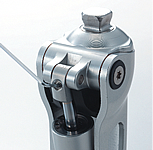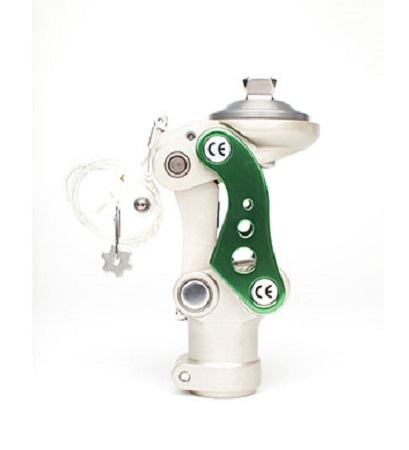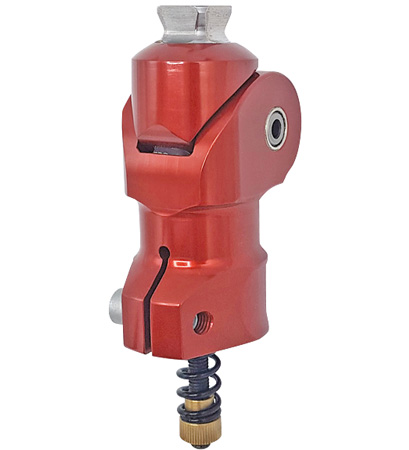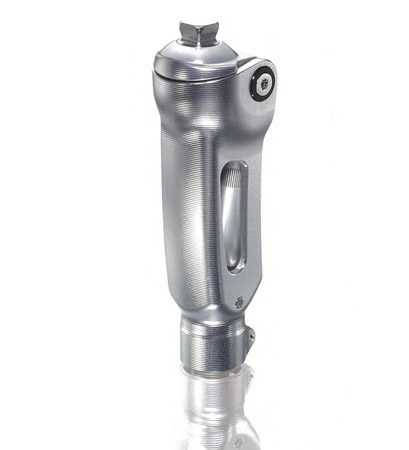
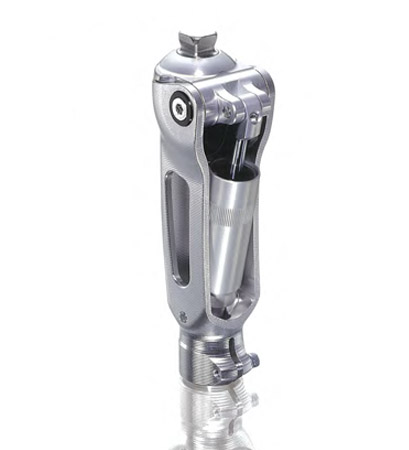
Description
| CODE | DESCRIPTION |
| KNJ621 | Dolphin Hydraulic Single Axis Compact Knee 100kg |
| Activity Level | 3~4 |
| Body Weight Limit | 100 kg |
| Weight | 495 g |
| Overall Length | 184 mm |
| Overall Width | 54 mm |
| Material | Aluminum Alloy |
| Swing Phase Control Mechanism | Hydraulic Cylinder |
| Maximum Bend Angle | 180′ |
Adaptability
The Dolphin is a knee joint designed to give users who weigh up to 100kg voluntary control. It supports dynamic motion for active walking and light exercise.
Lightweight, Slim, and Compact
The Dolphin’s main structural components use aluminum alloy for weight reduction.
Extremely Stable Knee Axle Position
The Dolphin is designed with the knee axis positioned toward the back, enhancing stability during the early stance phase. Voluntary knee joint control can be exercised using less muscle strength.
The Dolphin is ideal for users who are already proficient with voluntary-control knees, such as users who have been keeping the brake sensitivity of their load brakes to a minimum as well as current users of floating single axis knees.
The gait of users who are in voluntary control looks more natural.
A Hydraulic Cylinder to Help with Pre-Swing
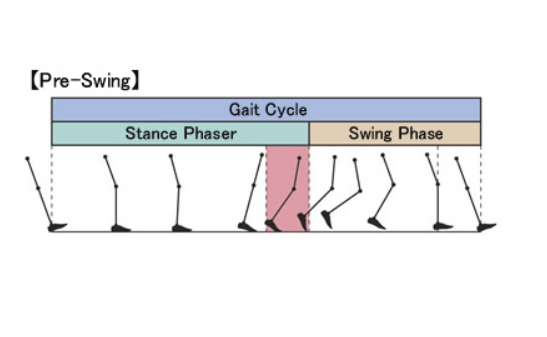
Flexion of the knee joint which takes place at the final stage of the stance phase is referred to as “pre-swing,” short for “preliminary flexion of the knee joint towards the swing phase”.
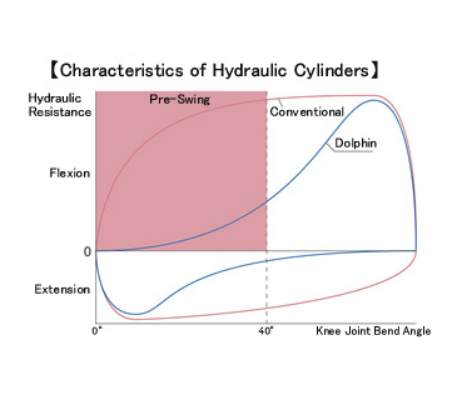
The ease of Pre-Swing performance influences the smoothness of the gait. Knee joints that provide an easy pre-swing make the lower leg feel lighter and allow for smoother transitions to the swing phase. On the contrary, a difficult pre-swing makes the leg feel heavy when swung, making it impossible to achieve a smooth transition to the swing phase. The characteristics of the knee joint’s hydraulic cylinder have an effect on pre-swing. With hydraulic cylinders that generate a strong hydraulic resistance during flex initiation, this strong resistance can hinder motion and make pre-swing difficult. The large majority of conventional hydraulic knees have had difficulty with pre-swing, causing them to be poorly evaluated by amputees (“oil pressure knees make knee-swing heavy”) and to be avoided as a result.

Less hydraulic resistance during the start of bending results in smoother use. Because the Dolphin has an easy pre-swing, swinging the leg feels light and easy, and transition to the swing phase can occur smoothly. Afterwards, as the bend angle increases, the hydraulic pressure also slowly increases, matching the user’s walking speed and controlling heel kick.
Making Adjustments
Adjusting Flexion Resistance
Flexion resistance on the Dolphin can be set by rotating the hydraulic cylinder by hand without the need for any special tools. Looking at the Swan from behind, turning it clockwise increases flexion resistance, and turning it counter-clockwise decreases flexion resistance. The maximum flexion resistance of the Dolphin is the highest among all our company’s products. This joint has outstanding gait adaptability that makes it ideal for users who engage in active walking and light exercise.
Adjusting Extension Resistance
Extension resistance can be adjusted by using a six-sided wrench to turn the adjustment screw on the upper part of the hydraulic cylinder. Turning the adjustment screw clockwise increases extension friction, and turning it counter-clockwise reduces extension friction.